For natural lifters training for size
See if every muscle got enough sets, every week.
Log your sets. The app tallies the week and shows what’s left.
Didn’t open? Tap ⋯ and choose open in browser. Inside Instagram, Google sign-in doesn’t work.
Runs in your browser · no ads · works offline
NattyCore uses only your name and email from Google. Nothing is posted to your account.
How much did each muscle train? Sets this week, muscle by muscle. Finished the set? Tap ✓ A set counts with up to 3 reps left. The helper muscle counts half a set Bench press: 1 set for chest, ½ for triceps. Shoulders: 8 sets this week 2 short of the minimum of 10. The range goes up to 20.
Your program tells you what to do. Not whether each muscle got enough.
NattyCore adds up each muscle’s sets for the week, counts half a set for muscles that only assist (bench press gives triceps half a set), and shows on the map what’s left.
Sets this week, by muscle
Example weekThis week’s counted sets, and how many are left to hit the minimum of 10.
- Machine Lateral Raise6
- Overhead Press4 × ½ = 2
The Shoulders number is the side delts, the only part with a minimum. Front (10) and rear (9.5) delts count separately, with no minimum.
- Chest12
- Back13
- Shoulders8
- Biceps10.5
- Triceps11.5
- Forearms2
- Core3
- Glutes7
- Quadriceps6
- Hamstrings5.5
- Calves4
How it works
Three screens replace your spreadsheet.
Didn’t open? Tap ⋯ and choose open in browser. Inside Instagram, Google sign-in doesn’t work.
Runs in your browser · no ads · works offline
NattyCore uses only your name and email from Google. Nothing is posted to your account.
Read what the video shows
- How much did each muscle train? Sets this week, muscle by muscle.
- Today’s workout, by what’s left Follow the workout order. Edit it first if you like.
- Finished the set? Tap ✓ A set counts with up to 3 reps left.
- Rest starts on its own Based on the reps of the next set.
- The helper muscle counts half a set Bench press: 1 set for chest, ½ for triceps.
- Shoulders: 8 sets this week 2 short of the minimum of 10. The range goes up to 20.
- Compare weeks, not workouts One workout varies. The week shows the trend.
- More reps, same load That’s progress too. Top of the range on every set? Add load.
- 4 weeks of effort, 1 light In the light week, half the sets to recover.
Log the set
Each exercise shows what you did last time and, if you run the app’s block, today’s target too. Same as last time? Two taps, even with no signal.
Bench Press
ExampleLast time: 72.5 kg × 9, 9, 8, 8
Today: 72.5 kg × 10, 10, 9, 9 · stop at 1 to 3 RIR
- Set 172.5kg10reps
- Set 272.5kg10reps
- Set 372.5kg9reps
- Set 472.5kg9reps
Rest · 1:30 to 2:00Each logged set: chest +1, triceps +½, front delts +½.Chest0Triceps0In a spreadsheet that counts every set in full, each set would also be 1 for triceps and 1 for shoulders.
Each bench press set gives ½ to the front delts and nothing to the side delts, which is the Shoulders number.
See what’s left
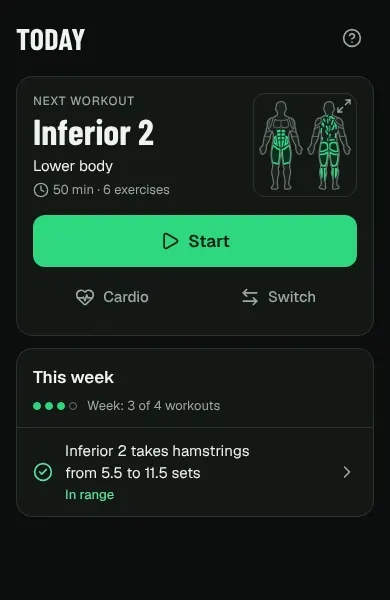
How many sets each muscle still needs to hit the minimum, and what your next workout covers.
See if you’re progressing
Your best set on each exercise this week vs. last week, and PRs the moment you hit them.
See your progress

Count it right
Bench press isn’t a full set for shoulders.
A spreadsheet that counts every set in full gives a whole set to every muscle involved and says your shoulders are in range. NattyCore splits the shoulder: the side delts, the part that needs direct work, got only 3.
Triceps
looks past the useful range
In range
Shoulders
looks in range
Below minimum7 to go
No minimum goalhit by almost every press
Same week: 8 sets of bench press, 6 of overhead press and 6 of triceps. The spreadsheet gives every muscle a full set; NattyCore gives half to the ones that assist.
See your progress
Same weight for more reps, within the range, is already progress. NattyCore compares week over week, exercise by exercise.
Bench Press
View as table
| Workout | Best set | Week |
|---|---|---|
| 08/17 | 7 × 72.5 kg | ↑ Went up |
| 08/24 | 7 × 72.5 kg | |
| 08/31 | 8 × 72.5 kg | ↑ Went up |
| 09/07 | 7 × 72.5 kg | |
| 09/14 | 9 × 72.5 kg | |
| Next target | 10 × 72.5 kg | |
On bench press, once every set hits the top of the range, the next target adds 2.5 kg and drops back to the bottom of the range.
Workout on 08/17: best set 7 × 72.5 kg.
Workout on 08/24: best set 7 × 72.5 kg.
Workout on 08/31: best set 8 × 72.5 kg.
Workout on 09/07: best set 7 × 72.5 kg.
Workout on 09/14: best set 9 × 72.5 kg.
Next: 10 × 72.5 kg on your best set, stopping at 1 to 3 RIR. That’s the target in the preview above.
14 of 28exercises went up
Counts exercises, not sets, and only completed weeks: it shows what went up, not how much the muscle grew.
Week 3 of 5
Week 1: done. 4 weeks trying to do a little more. Then 1 light week.
Week 2: done. 4 weeks trying to do a little more. Then 1 light week.
Week 3: this week. 4 weeks trying to do a little more. Then 1 light week.
Week 4: up next. 4 weeks trying to do a little more. Then 1 light week.
Light week: half the sets, same load, 3 to 4 reps left. After it, a new block starts.
Blocks of 4 weeks plus 1 light week are a coaching convention. What the studies support is volume, effort and progression.
Didn’t open? Tap ⋯ and choose open in browser. Inside Instagram, Google sign-in doesn’t work.
Runs in your browser · no ads · works offline
NattyCore uses only your name and email from Google. Nothing is posted to your account.
Already have a program?
The plan is fixed. Your week isn’t.
Your coach writes the program. NattyCore tracks the week you actually had: the machine that was taken, the day you missed, the short session. And the weekly count stays right.
Tap Swap for a similar one: you get the exercises that count the same toward volume, with the same main muscles, filtered to the equipment you have. If one counts differently, the screen tells you how. Your gym doesn’t have that machine? Swap it in the routine, for good, with the same sets.
Count the same in volume
Today only. The routine keeps Lat Pulldown.
Your next workout is the next one in the order, not whatever the weekday says. Missed Wednesday? On Thursday, Today shows the workout you skipped and how much it adds to the muscle that needs it most.
Workout B takes back from 6 to 10 sets
Tell it how much time you have, from 30 to 90 minutes, and today’s suggestion builds a workout that fits, based on what’s furthest behind this week, big muscles first. Whatever doesn’t fit moves to the next one. You edit it before you start.
Today's suggestion: Back, Shoulders, and Biceps · about 45 min
Choose At home under Equipment: the suggestion, the guided start and the similar exercises in a swap use only what you checked, and bodyweight always counts. The weekly count stays the same.
At home: dumbbells and pull-up bar
Workouts follow an order (A, B, C), not fixed days. The days you pick only organize your calendar and never count against you. Did 4 or more sets for a muscle less than 24 hours ago? Before you start the next workout in the order, the app tells you when that muscle will be rested, and never blocks you.
Resting until Thu, 18:00
Every suggestion shows why on screen, and Help explains each rule. You see the math, not just the answer.
And your coach stays in the loop: the report in Progress shows volume per muscle, best sets and the swaps you made. They can adjust the program to the weeks you actually trained.
Sample report · Swaps: Lat Pulldown for V-Bar Pulldown in 2 of 4 workouts
Never counted sets?
Why count sets
Muscle grows when you train it enough each week, with sets taken close to failure, and do a bit more (weight or reps) over time. Counting sets shows whether your week got there.
The sets that count
A working set that ends with 3 reps in reserve (RIR) or fewer counts, and so does one with no effort rating. Warm-ups don’t count, and a set that ends with 4 or more reps in reserve was too light to count.
E.g., 2 warm-up sets and 3 working sets on bench press = 3 sets for chest.
Why weekly
Studies measure each muscle’s total weekly sets. At the same total, training a muscle 2 or 3 times a week gives similar results, so missing a day doesn’t ruin the week.
The reference range: 10 to 20
More sets build more muscle, but each extra set adds less (a 2025 analysis of 67 studies). 10 a week is a good start; past 20, the extra gain is small and uncertain. Both numbers are coaching benchmarks, not limits of the body.
NattyCore runs this math on every set you log.See how it counts
Questions
Is it really free?
Yes. No ads, and we don’t sell your data. You can export or delete everything right in the app.
Do I need to download it from a store?
No. It runs in your browser at nattycore.app. To add the icon to your home screen: on Android, in Chrome, tap ⋮ → Install app; on iPhone, in Safari, tap Share → Add to Home Screen.
Does it need internet?
Only to sign in the first time. After that, you can log with no signal and it syncs when you’re back online.
Is it for beginners?
Yes. Just log weight and reps: the app does the math. The guided start sets each muscle at the 10-set weekly minimum and only suggests more if your progress stalls.
Does the app write my program?
Already have a program? Build your routines from it and the app tracks it. No program? It suggests today’s workout based on what’s left this week, and you edit it before you start. For an individual plan, see a qualified fitness professional.
Can my coach follow along?
Yes. In Progress, “Report for your coach” creates a PDF or a spreadsheet for the period you pick, with volume per muscle, best sets, training frequency and exercise swaps.
What if I’m not natural?
The count works for anyone. The ranges and how fast volume goes up were designed for lifters training without hormones. The app doesn’t ask.
Walk into the gym knowing what’s left.
Didn’t open? Tap ⋯ and choose open in browser. Inside Instagram, Google sign-in doesn’t work.
Runs in your browser · no ads · works offline
NattyCore uses only your name and email from Google. Nothing is posted to your account.